Beyond Visitor Numbers
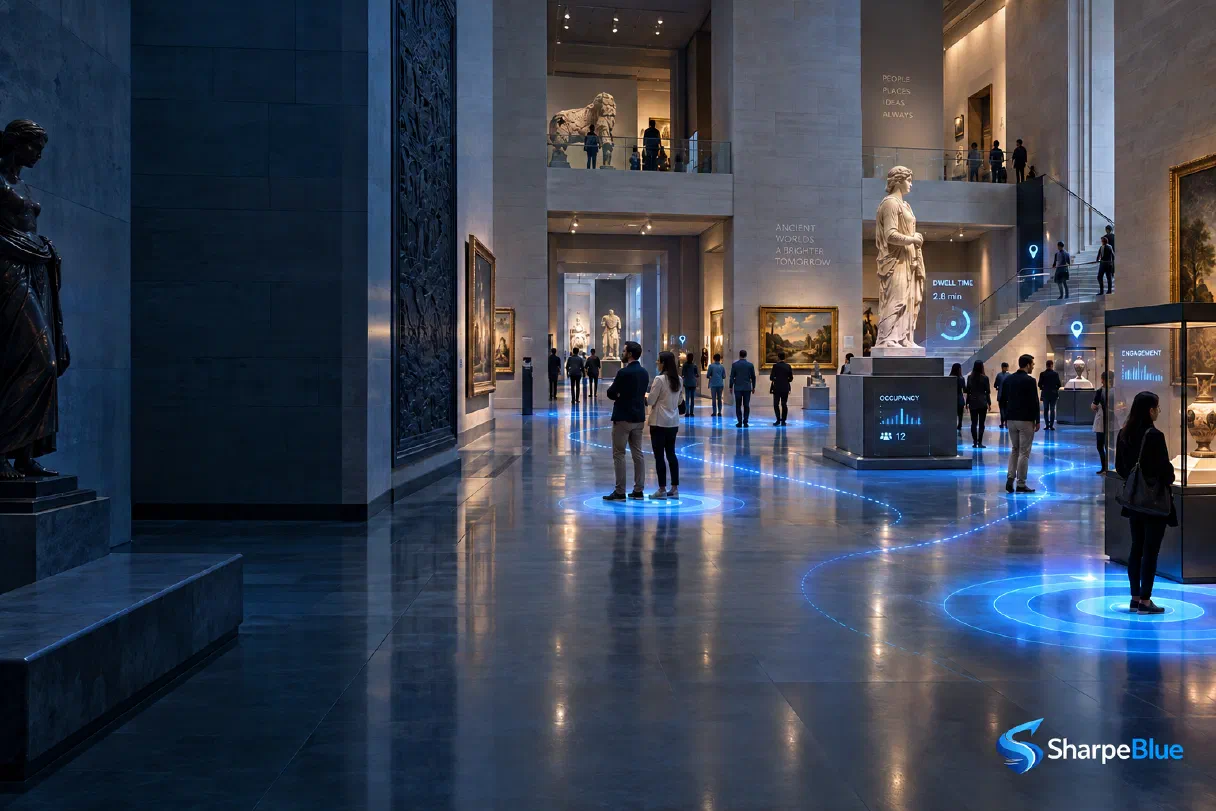
Discover how footfall analytics and spatial intelligence help museums improve visitor experiences, optimise operations and unlock new revenue opportunities.
How Footfall Analytics is Transforming Museums and Visitor Attractions.
Museums and visitor attractions know how many people visit.
What many don’t know is how visitors actually experience their spaces.
Every day, visitors make countless decisions: which galleries to explore, which exhibits to stop at, and which areas to walk straight past. Hidden within these movements is valuable intelligence that can help attractions improve visitor experiences, optimise operations, and unlock new revenue opportunities.
That’s where footfall analytics comes in.
The Louvre example shows why movement matters. From there, three practical priorities emerge: improving visitor experiences, strengthening commercial performance and running operations more efficiently. Spatial intelligence brings these applications together, with privacy as a foundation.
The Problem with Counting Visitors
Most attractions measure success through attendance figures.
Ticket sales, admissions and visitor numbers are important metrics, but they only tell part of the story.
They don’t reveal:
• Which exhibits attract the most attention
• Where visitors become lost or confused
• Which spaces suffer from congestion
• Which galleries are underutilised
• How visitors move through the attraction
Understanding visitor behaviour is often more valuable than understanding visitor volume.
Understanding the Visitor Journey
Footfall analytics analyses anonymous visitor movement to show how people use physical spaces. It goes beyond counting arrivals to reveal how visitors interact with an attraction.
Rather than simply counting visitors, attractions can understand:
• Popular visitor routes
• Dwell times around exhibits
• Visitor flow patterns
• Congestion hotspots
• Queue formation points
• Peak usage periods
This transforms operational decision-making from assumption-based to evidence-led.
For museum directors, curators and visitor experience teams, that insight can be game-changing.
What the Louvre Learned About Visitor Behaviour
One of the most compelling examples comes from the Louvre Museum in Paris.
Researchers from MIT’s Senseable City Lab analysed anonymised visitor movement data to understand how people navigate one of the world’s most visited museums. The study challenged several assumptions about visitor behaviour. [arxiv.org], [senseable.mit.edu]
The researchers expected visitors spending six hours in the museum to explore significantly more than those staying for less than 90 minutes.
Surprisingly, both groups followed remarkably similar routes, focusing on many of the same iconic attractions. Longer-stay visitors spent more time in the museum, but they did not necessarily visit substantially more locations. [arxiv.org], [senseable.mit.edu]
The study also found that visitors naturally gravitated towards a relatively small number of high-profile exhibits, creating predictable patterns of crowding despite the museum’s vast size. [arxiv.org], [senseable.mit.edu]
This highlights an important lesson for every visitor attraction.
Overcrowding is not simply a numbers problem. It is often a movement and behaviour problem.
Understanding how visitors move through a venue provides insights that attendance figures alone can never reveal.
Creating Better Visitor Experiences
When attractions understand visitor behaviour, they can make targeted improvements that enhance the overall experience.
For example:
• Improving signage where visitors commonly lose their way
• Redesigning layouts to encourage exploration of overlooked areas
• Reducing bottlenecks around popular exhibits
• Creating more balanced visitor flows
• Improving accessibility and navigation
Even small adjustments can have a significant impact on visitor satisfaction.
Unlocking Commercial Value
Footfall analytics also helps attractions improve commercial performance.
Understanding how visitors move through a venue can reveal:
• Retail conversion opportunities
• Café and catering demand patterns
• Optimal locations for membership promotion
• High-engagement areas for fundraising campaigns
• Performance of temporary exhibitions and events
By understanding visitor behaviour, attractions can increase revenue while maintaining a high-quality visitor experience.
Operating More Efficiently
Every visitor attraction must balance experience with operational efficiency.
Footfall analytics helps organisations answer practical questions such as:
• Where should staff be deployed?
• Which spaces require more frequent cleaning?
• When are visitor peaks likely to occur?
• Where are security resources most needed?
With increasing pressure on budgets and resources, data-driven operations can deliver significant value.
The Rise of Spatial Intelligence
Footfall analytics is evolving into something even more powerful: spatial intelligence.
Spatial intelligence connects visitor movement with the context of the venue. By combining movement data with digital maps, venue assets, accessibility information and operational data, attractions can develop a real-time understanding of how their spaces perform.
This enables organisations to:
• Optimise visitor journeys
• Improve accessibility
• Plan exhibitions more effectively
• Identify operational inefficiencies
• Make better investment decisions
Instead of looking only at where visitors have been, attractions can understand why spaces perform the way they do.
Privacy First
Modern footfall analytics solutions are increasingly designed around privacy-preserving principles.
The focus is on understanding anonymous movement patterns rather than identifying individual visitors, enabling attractions to gain valuable insight while maintaining visitor trust and regulatory compliance.
The Future Belongs to Data-Driven Attractions
The most successful museums and visitor attractions of the future will not simply count visitors.
They will understand them.
They will know which exhibits inspire engagement, where journeys break down, and how physical spaces influence behaviour.
Footfall analytics turns movement into insight.
Spatial intelligence turns insight into action.
Because success is not measured solely by how many people walk through the door.
It’s measured by the quality of the experience they have once they are inside.
About SharpeBlue
SharpeBlue helps museums, visitor attractions and heritage organisations understand how people experience their spaces.
Our SpatialAI platform combines footfall analytics, spatial intelligence and location intelligence to reveal how visitors move, engage and interact across physical environments, helping organisations improve visitor experiences, optimise operations and identify new opportunities for growth.
Ready to See Your Attraction Differently?
The most successful attractions don’t just count visitors. They understand them.
SharpeBlue’s SpatialAI platform transforms visitor movement into actionable insight, helping museums and attractions make better decisions, improve visitor journeys and maximise the value of their spaces.
To discover how SpatialAI can help your organisation, visit sharpeblue.com/solutions or contact the team for an exploratory discussion.