Why Every Council Needs a Community Intelligence Strategy
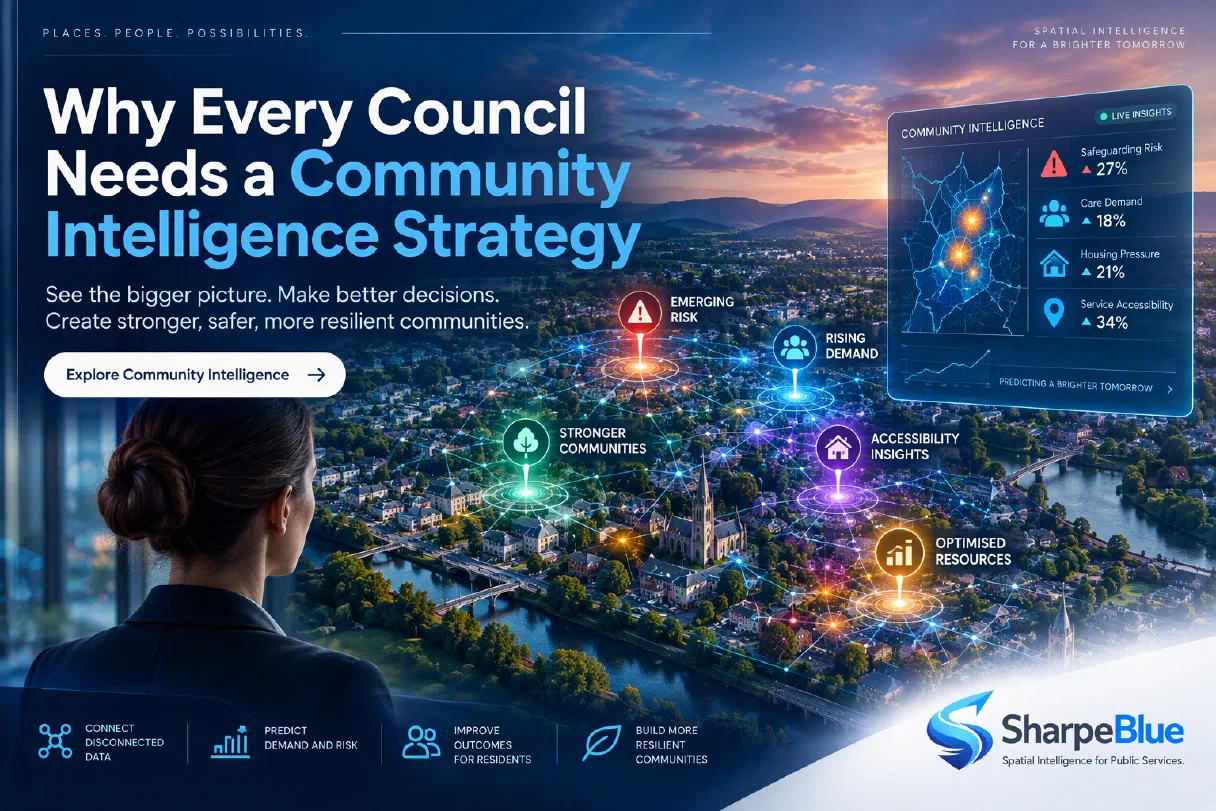
Community Intelligence enables councils to connect people, places, services, and data into a single strategic view of their communities. By combining spatial intelligence, predictive analytics, and place-based insight, leaders can identify emerging risks, forecast demand, allocate resources more effectively, and improve outcomes before issues escalate.
The Next Competitive Advantage in Local Government Is Not AI. It’s Community Intelligence.
The most effective councils of the next decade will not be those with the most data.
They will be the councils that can anticipate need, identify emerging risks, allocate resources with precision, and make better decisions faster than ever before.
In an environment of increasing demand, constrained budgets, workforce pressures, and growing community complexity, leaders need more than operational reporting. They need strategic foresight.
They need Community Intelligence.
Councils Are Managing Growing Complexity
Chief Executives, Directors, and Cabinet Members face a difficult reality.
Demand is growing across almost every service area:
• Adult social care
• Children’s services
• Housing and homelessness
• Community safety
• Public health
• Transport and mobility
• Place and regeneration
At the same time, financial pressures continue to increase while expectations for outcomes remain high.
Most councils already possess significant volumes of data.
The challenge is not information scarcity.
The challenge is turning fragmented information into actionable intelligence.
The question for local government leaders is no longer:
“Do we have enough data?”
It is:
“Do we have enough insight to make better decisions?”
The Shift From Service Intelligence to Community Intelligence
Most councils are organised around services.
Each service generates valuable insights.
Each team reports performance.
Each department manages its own priorities.
Yet communities do not experience council services in isolation.
Residents experience outcomes.
A housing issue can become a safeguarding issue.
A transport barrier can become a health issue.
Social isolation can become a demand pressure across multiple services.
Community Intelligence connects these relationships.
Rather than viewing challenges through departmental lenses, it creates a holistic understanding of how people, places, services, and environments interact.
This enables leaders to understand the community as a system, not as a collection of disconnected services.
Better Decisions Start With Better Visibility
The most strategic decisions in local government rely on understanding three critical questions:
Where is demand increasing?
Understanding future demand enables councils to deploy resources proactively rather than reactively.
Where is risk emerging?
Early identification of vulnerabilities allows intervention before issues escalate into crises.
Where can resources deliver the greatest impact?
In an era of constrained funding, every decision must maximise social value and community outcomes.
Community Intelligence provides a framework for answering all three.
From Reporting the Past to Predicting the Future
Traditional performance reporting is valuable.
But reporting tells leaders what has already happened.
Community Intelligence helps leaders understand:
• What is happening now
• Why it is happening
• What is likely to happen next
• Where intervention will have the greatest impact
This represents a fundamental shift in capability.
It moves councils from managing activity to managing outcomes.
From responding to demand to anticipating demand.
From reacting to risk to preventing harm.
Community Intelligence as Strategic Infrastructure
Forward-thinking councils are beginning to treat intelligence as infrastructure.
Just as transport infrastructure enables movement and digital infrastructure enables connectivity, Community Intelligence enables better decision-making.
It provides leadership teams with a shared operating picture across people, places, demand, risk, and outcomes.
This creates a more connected and informed organisation.
One capable of:
• Identifying emerging community pressures
• Improving place-based decision-making
• Strengthening safeguarding capability
• Supporting workforce optimisation
• Improving resource allocation
• Delivering better citizen outcomes
Most importantly, it helps leaders move beyond assumptions and make decisions based on evidence.
The Five Capabilities of a Community Intelligence Council
1. A Single View of Place
Connecting information across services to create a shared understanding of communities.
2. Spatial Understanding
Understanding where risk, demand, and opportunity exist across neighbourhoods and places.
3. Predictive Insight
Forecasting demand, identifying emerging trends, and enabling earlier intervention.
4. Operational Decision Support
Embedding intelligence into frontline and strategic decision-making.
5. Outcome Visibility
Measuring impact across communities rather than individual service silos.
Together these capabilities create a council that can anticipate, adapt, and respond more effectively.
Why Community Intelligence Matters to the Executive Team
For Chief Executives, Directors, and elected leaders, Community Intelligence is not a technology initiative.
It is a leadership capability.
It supports:
Better Strategic Planning
Understanding future demand and long-term community needs.
Better Financial Decisions
Targeting investment where it delivers the greatest impact.
Better Risk Management
Identifying vulnerabilities before they become major issues.
Better Outcomes
Aligning services, resources, and interventions around community priorities.
Ultimately, it enables leaders to govern with greater confidence and greater visibility.
The Future Council Is Predictive
The pressures facing local government are unlikely to diminish.
Demand will continue to rise.
Workforces will remain stretched.
Community needs will become increasingly complex.
The councils that thrive will be those that can see further than the next reporting cycle.
Those that can identify opportunities before they are visible.
Those that can make decisions based on intelligence rather than hindsight.
Community Intelligence provides that capability.
It represents the next evolution in place-based leadership.
And for many councils, it may become the defining capability of the next decade.
Discover SharpeBlue Community Intelligence
SharpeBlue helps councils move beyond fragmented reporting and towards intelligence-led decision-making.
Using SpatialAI, predictive modelling, behavioural insight, and place-based intelligence, leaders gain a deeper understanding of community needs, emerging risks, and future demand.
Because the future belongs to councils that can anticipate, not just respond.