How Predictive Risk Models Reduce Harm in Care and Local Government
How Predictive Risk Models Reduce Harm in Care and Local Government
How Predictive Risk Models Reduce Harm in Care and Local Government
Every incident has a story — and almost every story has signals that appeared long before harm occurred. Predictive risk models help councils and care providers detect these signals early, intervene sooner, and prevent harm before it happens.
This is the shift from reactive safeguarding to proactive protection.
Why Harm Happens: The Pattern Behind the Pattern
Incidents rarely occur in isolation. They emerge from a combination of:
- Behavioural changes
- Environmental pressures
- Operational gaps
- Missed signals
- Fragmented data
Predictive risk models identify these patterns and quantify risk in real time.
What Predictive Risk Models Actually Do
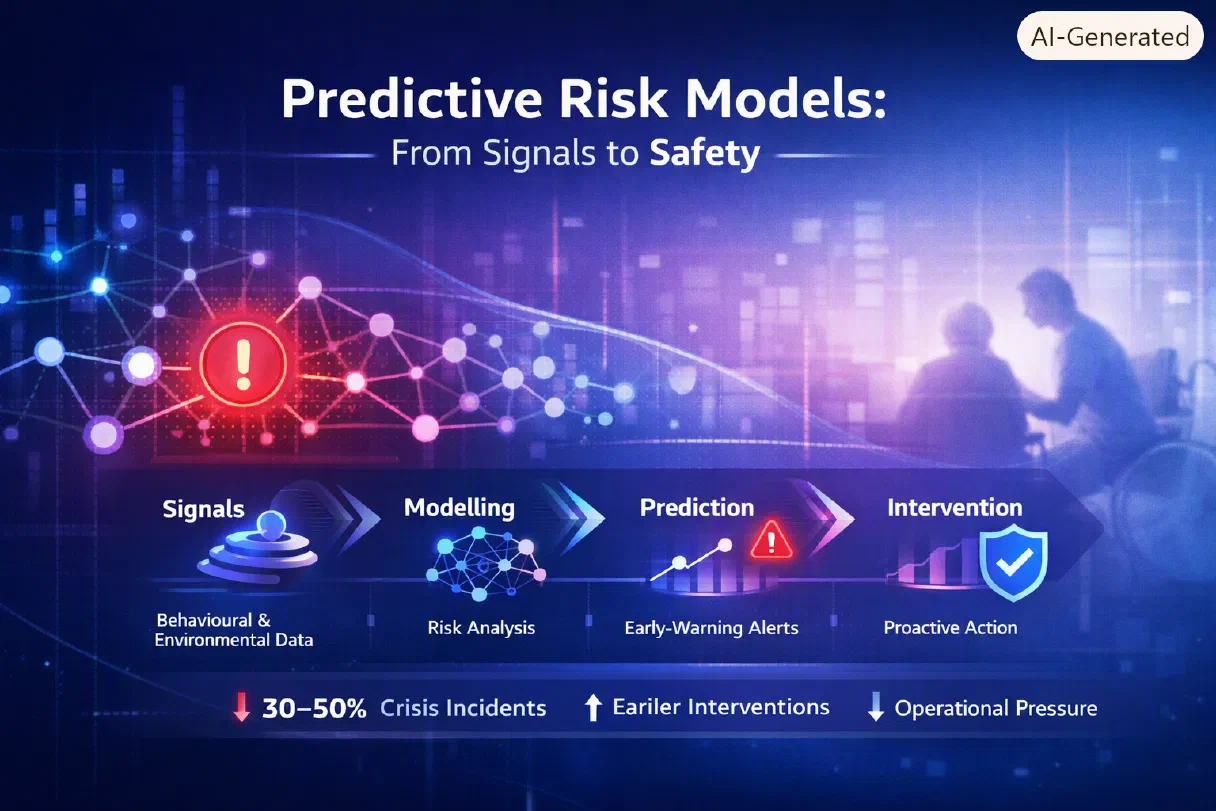
1. Detect Early‑Warning Signals
Models analyse thousands of micro‑signals:
- Changes in routine
- Location‑based risk
- Environmental stressors
- Historical patterns
- Workforce activity
2. Predict Likelihood of Harm
They generate risk scores and trajectories — not to replace human judgement, but to enhance it.
3. Prioritise Intervention
Teams know who needs help, when, and why.
4. Reduce incidents
Councils and care providers consistently see:
- Fewer safeguarding incidents
- Earlier interventions
- Better resource allocation
- Reduced crisis response
Case Examples (Anonymised)
Care Provider
A provider reduced hospital admissions by identifying early‑warning signals linked to mobility changes and environmental stress.
Council
A local authority improved safeguarding outcomes by detecting risk clusters across neighbourhoods and prioritising proactive outreach.
Venue Operator
A visitor attraction reduced crowd‑related incidents by predicting flow‑related risk before peak periods.
Privacy & Ethics: Non‑Negotiable
Predictive risk must be:
- Privacy‑preserving
- Transparent
- Explainable
- Responsible
- Operationally safe
SharpeBlue’s Risk Engine uses differential privacy, federated learning, and strict governance to ensure compliance and trust.
The SharpeBlue Advantage
SharpeBlue’s Risk Engine is built for high‑risk environments. It delivers early‑warning signals that frontline teams can act on immediately — without compromising privacy.
Prediction isn’t about technology. It’s about preventing harm.