Museums Need More Than Visitor Counts
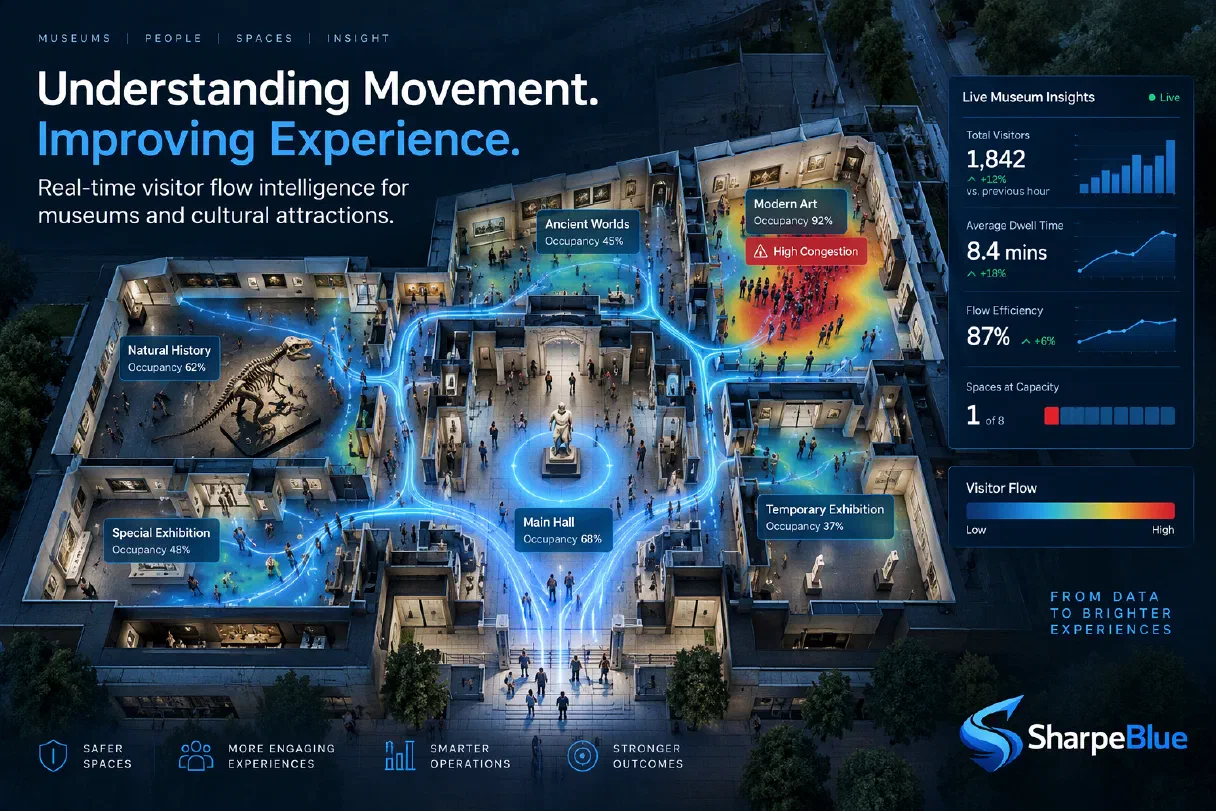
Learn how leading museums are using real-time visitor flow intelligence to improve safety, optimise resources and deliver better visitor experiences.
Museums Need More Than Visitor Counts
Museums have become highly sophisticated at measuring attendance.
Yet attendance only tells part of the story.
What matters is what happens after visitors walk through the door. Which galleries are becoming congested? Where are visitors engaging most? When is intervention needed to protect visitor experience and safety?
Without real-time visibility, these questions are often answered through observation and hindsight.
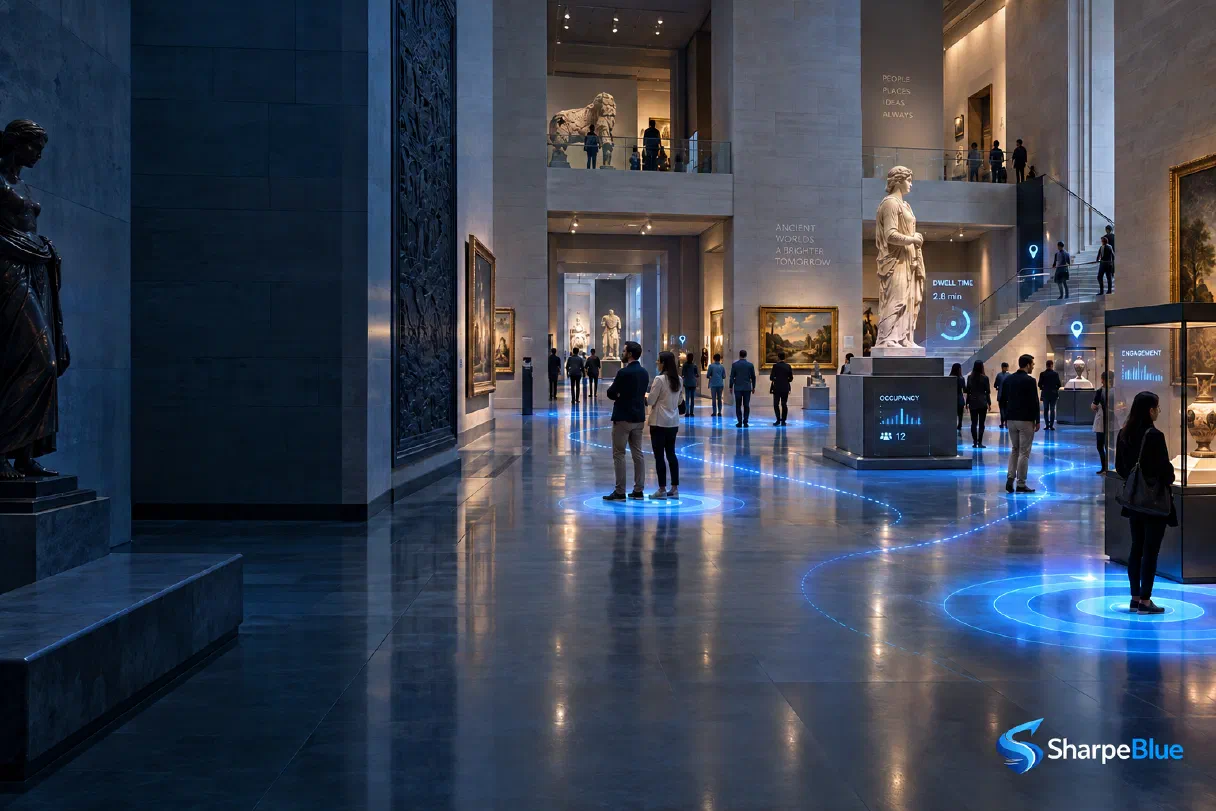
Today, advances in sensors and AI-powered analytics allow museums to understand visitor movement as it happens. The result is better operational decisions, safer environments and stronger visitor experiences.
At SharpeBlue, we call this Spatial Intelligence.
The Visibility Gap
Most museums know how many visitors arrived.
Far fewer know what is happening across their estate in real time.
Questions such as:
• Which galleries are approaching capacity?
• Where are queues forming?
• Which exhibits are driving the highest engagement?
• Where should staff be deployed?
• Are visitor routes operating as intended?
cannot be answered through ticketing systems alone.
The UK Health and Safety Executive identifies congestion, overcrowding and restricted circulation routes as key crowd-management risks in public venues, highlighting the importance of understanding how people move through a space, not simply how many enter. [hse.gov.uk].
This is no longer just an operational challenge. It is a strategic one.
Leading Museums Are Already Responding
Forward-thinking museums are already investing in better ways to understand visitor behaviour and manage demand.
The British Museum uses visitor analytics, intelligent counting data, Wi-Fi data and visitor feedback to inform operational decisions and improve visitor experience. During periods of exceptional demand, visitor flow management becomes critical to maintaining accessibility and experience. [turing.ac.uk], [museumsassociation.org].
The Natural History Museum encourages advance booking and highlights the importance of managing visitor demand during busy periods. [nhm.ac.uk]
The Mary Rose Museum uses timed ticketing to manage finite capacity and has highlighted the operational challenges created when visitors spend longer than expected engaging with exhibits. [cladglobal.com]
Different institutions. Different operating models.
The same challenge:
How do you understand what is happening across your estate right now?
From Monitoring to Intelligence
Modern visitor flow monitoring combines occupancy sensing, movement analytics and Spatial Intelligence to create a real-time understanding of how visitors use a museum.
This enables organisations to:
• Detect congestion before it impacts visitors
• Improve crowd safety
• Optimise staffing and resources
• Understand visitor journeys and dwell times
• Make evidence-based decisions in real time
Importantly, modern systems increasingly achieve this through privacy-preserving technologies that focus on movement patterns rather than personal identities.
Why This Matters
Research continues to demonstrate the value of understanding visitor behaviour through positioning and sensor-based analytics. These technologies provide a clearer picture of how visitors interact with spaces and exhibits, supporting improved operational planning and visitor experiences. [mdpi.com], [publikace.nm.cz]
As visitor expectations continue to rise, museums are expected to be safe, engaging, accessible and efficient.
Meeting those expectations requires more than attendance reporting.
It requires operational intelligence.
Because the future of museum management is not about knowing how many people visited.
It is about understanding how they experienced the space.
Ready to Lead With Spatial Intelligence?
SharpeBlue’s SpatialAI platform provides real-time visibility of visitor movement, occupancy and engagement, enabling better decisions, safer environments and stronger visitor experiences.
If visitor experience is a strategic priority, understanding visitor flow is a strategic capability.
Book a live SpatialAI demonstration to see how real-time visitor flow intelligence can help your museum identify congestion hotspots, optimise operations and enhance the visitor journey.
The next competitive advantage is not collecting more visitor data. It is understanding what it means.